
Miami Directory Collections by Year
Miami city directory research begins with a scattered but well-documented group of print, microform, and digital sources. The oldest verified directory is tied to the year Miami incorporated. Later Polk books and telephone directories show a fast-growing region, but no local institution publishes a complete online shelf list. Treat the years below as verified anchors, not a claim that every intervening edition survives.
| Collection | Verified years | Where held | Access |
|---|---|---|---|
| Dade County directory, guide, and history | 1896-97 | University of Miami Florida Collection | Special collections or reprint |
| First Miami telephone directory | About 1899/1900 | Florida Memory | Free digital reproduction |
| R.L. Polk Miami and Greater Miami | 1926, 1928-30, 1933, 1935, 1937, 1940, 1942 | MDPLS and HistoryMiami | Mostly in person or by appointment |
| Miami telephone books | 1933, 1938-39, 1940-41 | Library of Congress | Free page-image browsing |
| Florida censuses | 1885, 1935, 1945 | MDPLS microforms and digital sources | Library or online access |
| Sanborn maps | 1914, 1921, revisions through 1940 | Library of Congress and libraries | Digital or library access |
Ask staff about missing years and reverse sections before planning a visit. Shelf holdings can exceed what a web catalog lists. A directory title also may describe “Greater Miami,” so the title page matters as much as the entry page.
Miami Directories Before Polk
The University of Miami catalog record identifies the 1896-97 Business Directory, Guide and History of Dade County, associated with C.M. Gardner and C.F. Kennedy. It belongs to the county era as well as the newly incorporated city. That broad title warns against reading an entry as proof of residence inside modern Miami boundaries.
Florida Memory reproduces Miami's first telephone directory, dated about 1899 or 1900. Early telephone books are selective. They record subscribers, not every adult or household. Still, a name, address, and number can place a subscriber at a useful point between censuses and supply a spelling for the next search.
| 1896 | Miami incorporates; the Dade guide provides an early directory anchor. |
|---|---|
| About 1899/1900 | The first telephone directory documents an early subscriber network. |
| 1920s | Verified R.L. Polk volumes begin the better-known directory run. |
| 1930s-1940s | Greater Miami titles and digitized telephone books widen regional coverage. |
Decode a Miami Directory Entry
A Polk-style alphabetical entry commonly starts with surname and given name or initials. A spouse may appear in parentheses. The line may then give a trade or employer and a home address. “r” means resides, “h” points to the home or householder, “bds” means boards, and “wid” marks a widow. Conventions change between editions, so save the abbreviation key from each volume.
| Name | Surname, first name or initials; check variant spellings. |
|---|---|
| Spouse | Often shown in parentheses, depending on the year. |
| Work | Occupation or employer, sometimes abbreviated. |
| Home address | House number, quadrant, and street as printed that year. |
| Telephone entry | Subscriber name, address, and number rather than a full household. |
Miami names require care with accents, compound surnames, two-surname forms, and changes in maternal or paternal order. Start with the exact printed form. Then try a controlled shorter form rather than blending two people whose names happen to look alike.
- Criss-cross directory
- A section arranged by street and house number instead of by surname.
- Householder index
- A list centered on the person associated with a home address; it is not always a full household roll.
- Abbreviation key
- The volume's own legend for short forms such as occupations, residence marks, and marital notes.
Miami Telephone Books Online
The Library of Congress 1938-39 Miami telephone directory contains 569 digitized images. Sequential viewing is often more reliable than OCR, the computer-generated text that can misread worn print and compressed names. The Library also verifies Miami telephone directories for 1933 and 1940-41. Record the image or page number, not just the search result.
The printed 1933 service area included Miami Beach, Coral Gables, Miami Springs, Hialeah, North Miami, and South Miami. That is a major geography trap. A hit in a Miami volume can belong to another municipality. Read the title page and service-area statement before assigning a City of Miami location.
Miami's Genealogy Library Shelf
The Main Library at 101 W Flagler Street is the largest practical directory desk in the city. Its Genealogy Collection holds more than 27,000 bound volumes and 35,000 microforms. Most are for library use. Materials are arranged by state and then by topics such as family, ethnic, church, immigration, military, and general reference sources.
Before visiting, open the MDPLS Genealogy Digital Collection to review collection notes and digital items. Reference librarians can help onsite or through e-reference. Useful companions include city directories since the 1920s, telephone indexes, the Miami-Dade Obituary Index, Florida censuses, passenger lists, World War I draft cards, surname files, and alien arrivals by airplane at Miami from 1930 through 1942.
The linked MDPLS collection shows the digital entry point used to plan Miami city directory work:
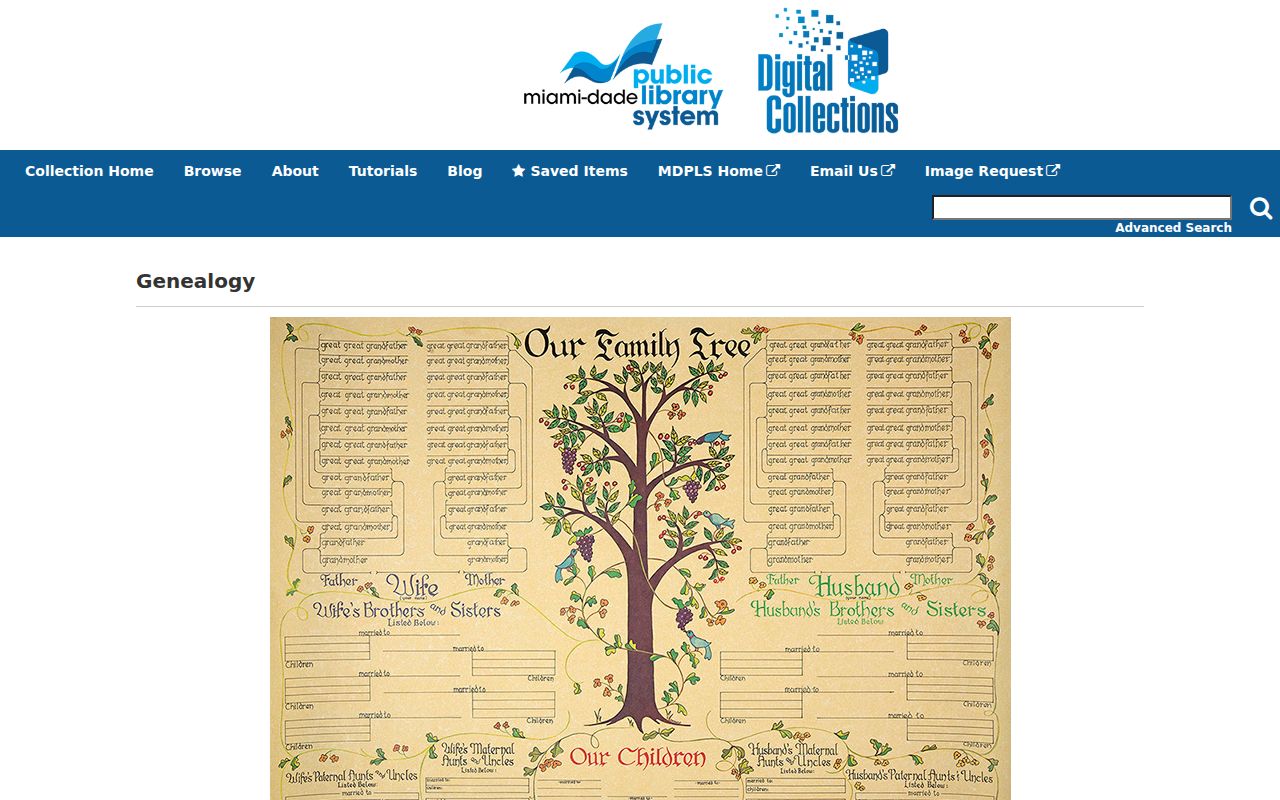
The screenshot helps distinguish online items from the far larger set that still requires library access.
Miami Directories by Appointment
HistoryMiami's Research Center holds city directories, yearbooks, scarce newspapers, maps, manuscripts, family and organization papers, and ephemera. Its 1.5 million photo prints and negatives date from 1883. The Woodrow W. Wilkins architectural archive can add plans and visual context to an address found in a directory.
The reading room is appointment-only. Published hours are Tuesday through Thursday, noon to 4:30 p.m., and Friday, 10 a.m. to 4:30 p.m. Contact staff at 305-375-1623 or archives@historymiami.org, and verify hours when booking. Send names, years, neighborhoods, and known addresses in advance so staff can identify likely boxes or volumes.
Note: Current directories and private membership lists should not be assumed public merely because an archive holds older organizational records.
Trace Miami Families Across Editions
A city directory becomes far more useful as a sequence. One entry gives a snapshot; several show when a household appears, moves, changes work, or disappears from a listing. Pair the sequence with public census schedules and property records, but keep occupants separate from legal owners.
- Choose a known year and search the alphabetical section for the household head and spouse.
- Save the exact address, quadrant, occupation, spelling, page, and title.
- Check a street or reverse section, if present, for the same address and nearby listed names.
- Move one edition at a time and mark the first and last appearances.
- Pair 1930, 1940, or 1950 findings with federal census schedules; use Florida's 1935 and 1945 censuses between decades.
- Confirm ownership separately through deeds rather than treating the listed occupant as the owner.
The federal 72-year rule makes 1950 the latest public population schedule in 2026. A person missing from one edition may have moved, died, stopped subscribing, or simply been omitted. The obituary index, probate filings, newspapers, and the Miami resident search can test those paths without guessing.
Greater Miami Directory Geography
“Greater Miami” grew as a publishing and telephone-service label while the metropolitan area expanded. It is not the same thing as the City of Miami. The broader volumes can include Coral Gables, Miami Beach, Hialeah, Miami Springs, North Miami, and South Miami. Each result needs its printed municipality or address checked against the edition's own scope.
Neighborhood eras also shape the shelf. Downtown, Overtown, and Coconut Grove appear in early sources. Post-1959 Little Havana research benefits from Spanish-language newspapers and community collections. Little Haiti's later record trail may require Haitian Creole sources, while historic airline employee material at University of Miami can help identify people tied to Pan Am or National Airlines.
Verify Miami Directory Gaps
Neither MDPLS nor HistoryMiami publishes a complete online list of every Miami city directory or criss-cross year. Do not fill a missing year by assumption. Ask the reference desk to check the catalog, shelf, and microform holdings. Then try the other local repository, the Library of Congress, Florida Memory, University of Miami, or the State Archives.
Older streets may also change form. Miami Avenue divides east and west, while Flagler Street divides north and south. Preserve NW, NE, SW, or SE because dropping the quadrant can identify another address. When a street string fails, compare the historical spelling with plats, Sanborn maps, and the modern Miami street address directory.